Showing posts with label news. Show all posts

Sunday, March 18, 2012

LA Times goes on a Bus trip

Smiles and smiles to go in a VW bus


By Kari Howard, Los Angeles Times
Sun Mar 18 2012 12:00 AM
The first smile came from the mechanic at the Jiffy Lube at the bottom of the hill. You know you're on to something good when you can make a tired guy light up, even if it's just for a second, at the end of a long workweek.

By the time the weekend was over, we'd amassed way too many smiles to count and moved on to peace signs. (My favorites: from the surfer who looked like a bleached-blond Jesus and the panhandler who carried a sign saying, "I won't lie. I need beer.")

I'd like to think it was because we gals were so fetching, but I must admit it was probably — OK, certainly — the thing we were riding in: a spring-pea-green vintage VW camper with a paint job so shiny you could imagine that it was 1979 and that we'd just driven it off the showroom floor.

It was my birthday, and I wanted to do something different this year. VW buses have always been a personal good-luck charm; I make a wish whenever I see one. So when I found an outfit in Orange County called Vintage Surfari Wagons that restores and rents them, I knew it was time for a vintage VW road trip up the Southern California coast.

Saturday, October 8, 2011

Desperate Hippie

Desperate Hippie: Teri Hatcher recaptures flower power era with her seventies VW van


By Daily Mail Reporter
Last updated at 9:48 AM on 26th July 2011


This is how to make a teenage daughter cringe.
Teri Hatcher is clinging onto her youth by recapturing the magic of the flower power era and driving around in a VW van.
The Desperate Housewives actress looked thrilled behind the wheel of her vehicle, but 13-year-old daughter Emerson might think differently.  
Happy camper: Teri Hatcher grins behind the wheel of her van

Hippie chic: Actress drives her van to meet a friend for a hike
Despite her 46 years, and millions of dollars in the bank, it is quite endearing to see that Teri still opts to drive the 1974 model.
It's a refreshing sight for a Hollywood star to jaunt around in something a little quirkier than a Ferrari with a personalised number plate.


Teri, who starred as Lois Lane in a TV spin-off of Superman in the nineties, rode to Brentwood to meet a friend, before embarking on a hike.
As the pair set off on their expedition, the petite brunette looked typically tiny in her figure-hugging gym kit.
Teri's fitted trousers showcased her slender thighs, without an ounce of spare flesh.
Stepping back in time: Teri recaptures her youth with old school vehicle
Living in LA, Teri's vehicle is no exception to the rule when it comes to making headlines.  
The Golden Globe-winner sued a British tabloid after they reported she had been having wild sex inside the van while parked outside her home.
Hatcher won the case, with the Daily Sport forced to admit the allegations were 'entirely false' and had to pay up undisclosed libel damages. 

Why customising cars is still cool

Why customising cars is still cool

02 August 11 19:04 ET

By Helen Soteriou
BBC News

Burbank, North Hollywood, California


Meet George Barris. You might not recognise the name, but you might just recognise the car next to him.

He is the man responsible for designing the iconic Batmobile for the 1960s Batman TV show, as well as other famous movie cars.

George, not one to shy away from self-promotion, styles himself as the "king of the kustomizers".

Customising involves enhancing the styling, functionality and performance of vehicles, and George has been "tricking out" cars since 1940.

As a reward for helping out at the family restaurant, George and his brother Sam were given a 1925 Buick. They fixed it up and experimented with the appearance of the car, which they then sold on for a profit.

After trips to the hardware store to pick up some paint, and the kitchen store to get some pots and pans for hubcaps, George then proceeded to take all the knobs off his mum's dressing room cabinet doors to use in the car's grille.

"But when I got home that night, and poor mum couldn't get in her cabinets because I had all the knobs off - I was grounded for a week," he reminisces.

Hollywood stars

His first job was about a year later, customising a car with a set of cat-eyed tail lights for which he charged $10. From here he moved to LA and was involved in illegal street drag racing.

The movie industry took an interest in this world because it was colourful and exciting, and there were many stories to tell about racing in the streets and crashing.

This marked the beginning of his customising work for films, with High School Confidential being his first movie project.

And as Hollywood increasingly fell in love with George's ideas, so did the Hollywood stars passing through the doors of his shop in Burbank, North Hollywood, requesting a Barris creation.

John Wayne, Elvis Presley, the Beatles, Frank Sinatra, Dean Martin, and Sonny and Cher are just a few names that came to George wanting something special for their vehicle.

"Sonny and Cher came to me, and they were going to do a movie, and Ford says here's a Mustang for them," says George.

"So I said to Cher, 'What colour would you like?' and she said, 'I want hot pink, white fur, white patent leather'. Sonny said 'I'm not going to drive a pink Mustang', so I said, 'okay I will get you two, a his and hers'.

"His, I put leopard skin in it. I painted it in gold. Hers is in pink with white pearls."

But when did customising actually start?

Peter MacGillivray is vice president of events at Sema, an organisation that represents accessory manufacturers, distributors and marketers in the customising industry.

"The [customising] industry was born after World War II. Some theories suggest that service men and women got a taste of high horsepower aircraft engines during the war - they translated that knowledge and interest into grassroots motorsports activities after the war," he says.

At about the same time, US consumers began to form car clubs, compete in races and more importantly, modify their vehicles to perform better, he adds.

Mr MacGillivray believes that customising took off in the mainstream because the notion of personalisation had become part of our culture.

He also states that popular culture, such as music, movies and TV shows have embraced customised cars.

"Heck, the most popular video games in the world are automotive-related and they feature customised cars," he says. "Consumers are inundated with messages that customising is cool."

Interdependent industry

But interestingly, due to changing consumer trends, the big car makers are not able to stay on top of consumer tastes, so they are not the ones making a lot of revenue in this area.

"The typical Sema manufacturer is a small business that is best suited to stay on top of the trends and tastes of the consumer," Mr MacGillivray says.

But despite being profitable, the industry has not been immune from the economic downturn.

And due to the interdependency of the industry, the economy has had a domino effect on the different businesses that are linked together.

"We were hit hard when the economy downturned as most of the products we offer are not necessary items and are discretionary income," says Mike Spagnola, president of Street Scene Equipment, which offers over 2,800 different parts for cars and trucks.

"Because we build most of our products in the United States, the downturn not only affected us, but our local suppliers as well.

"The good news was that we didn't need to import large quantities of products from overseas which allows us to keep our inventories in line."

Mr Spagnola believes the customising consumer falls into one of three categories: The "younger crowd", who has purchased a used car or truck and wants to individualise it. Such a person might buy a few accessories at a time as he or she has some extra money.

Secondly, the "over-50 crowd" who can now afford the car they always wanted and wants to do everything at once to make their car unique. That buyer might go to a dealership and order a car with the products already on, or leave the dealership and immediately want to accessorise the car.

And the third group are people who want products to make their car safe or roadworthy. This group tends to buy items such as replacement mirrors and mud flaps.

Mr Spagnola says that over the last few years he has seen a resurgence in older vehicles being accessorised as customers wants to keep their vehicle for longer instead of buying a new one.

As for George Barris, now in his 80s, his infectious love of designing cars is still prevalent to all who meet him.

And just like the customising industry, George shows no signs of slowing down anytime soon.

"You dream at it. Even at night when you are home and watching TV, and all of a sudden something goes by and you say 'oh, look at that, I can take that' and right away I'll sketch something."

Technology That Makes Left Feet Obsolete


Technology That Makes Left Feet Obsolete

Cars With Clutchless Transmissions Allow Drivers to Shift Gears Themselves, but Now There's No Need for a Floor Pedal


SEPTEMBER 7, 2011  

By JOSEPH B. WHITE


The Wall Street Journal

Fewer than 10% of the cars and light trucks sold in the U.S. last year were equipped with traditional manual transmissions and clutch pedals—even though a manual usually provides better fuel economy. New technology offers the fuel efficiency of a stick shift without the hassle of a clutch.

European car makers for several years have been expanding their use of clutchless, or automated, manual transmissions under various names, responding to consumer demand for fuel-saving technology in a market where fuel is expensive.

Now, clutchless manuals are crossing the pond.

Ford Motor Co.'s new Fiesta subcompact and Focus compact both come with a choice of a six-speed manual transmission as standard equipment, or a six speed "PowerShift" transmission, which is Ford's version of a clutchless manual.

Using PowerShift, the driver can choose between cruising along with the floor-shifter in "D" (for drive), letting the transmission's software do the shifting. Or the driver can pull the shift lever back one more notch to "S" (for shift) and press buttons on the side of the shift lever to change gears manually.

The D mode operates and feels like an automatic, except for a subtle but noticeable stutter when moving out of first gear. It's a catch familiar to someone who's driven an old-school manual—the car is engaging a clutch. But it has provoked complaints from some buyers of the new Focus. Ford has launched a campaign to educate buyers about the clutchless manual and is considering ways to recalibrate the transmission to smooth out the performance.

The PowerShift is currently a pricey option—it lists for about $1,000 on top of the roughly $16,500 starting price for the car. But it allows the Focus to get up to 38 miles per gallon on the highway, a 2-mpg improvement over the regular six-speed manual. A Focus SFE model equipped with PowerShift and other fuel-saving technology gets up to 40 mpg on the highway.

"Customers are getting used to it," says Craig Renneker, a senior Ford transmission engineer.

Even among cars favored by driving enthusiasts, clutchless transmissions are becoming the norm. At Porsche AG's U.S. arm, 55% to 65% of the buyers of Porsche sports cars buy a clutchless manual transmission, which is marketed as the PDK—short for "Porsche Doppelkupplungsgetriebe." The new 911 model making its debut in Frankfurt next week will be offered with a seven-speed manual or a seven-speed clutchless PDK. For most buyers, the PDK would be faster, says Alexander Schildt, manager of product planning for Porsche Cars North America.

"You need to be a world-class driver to beat the PDK" with a clutch manual, Mr. Schildt says.

Volkswagen AG offers clutchless-manual technology, which it calls DSG, in several models. General Motors Co. and Fiat SpA's Chrysler Group are considering the technology, the companies say. Meanwhile, auto makers are improving their conventional automatic transmissions to narrow the gap with manuals.

Some other auto makers, including Nissan Motor Corp., Honda Motor Co. and Subaru offer continuously variable transmissions, or CVTs, in certain models. CVTs eliminate both clutches and gears. Power is transmitted from the engine to wheels using a system of belts and cone-shaped pulleys.

Toyota Motor Corp.'s $400,000 Lexus LFA super cars use computer-controlled hydraulic systems to control gear changes and a single clutch. In lower-priced cars, company officials say, Toyota is likely to expand the use of an automatic transmission that can be operated in full manual mode. While the mechanics of these systems are different, the driver gets to choose whether to shift the gears, or not.

The upshot is that so few U.S. customers want what used to be called "standard shift," that auto makers are dropping manuals altogether from high-volume models, such as the Ford F-150 pickup.

Manuals are still available in some mass-market American cars mainly because they allow car makers to advertise a lower base price and provide better fuel-economy numbers than heavier automatic gearboxes. A good manual can make a car more fun to drive, which is why sports cars such as the Ford Mustang, Chevrolet Corvette and some high-performance European cars still offer manual gearboxes.

Learning the stick shift was once a rite of passage for many drivers in the baby boom generation. But fewer and fewer younger drivers are bothering to master the art.

"It's very rare to find it taught in modern driver education," says William Van Tassel, manager of driver training programs for the AAA national office, who says he drives a stick-shift 2004 Porsche 911. The AAA has a textbook that explains how it's done, but real-world practice is essential.

Car collectors and enthusiasts bemoan the demise of the stick, and some are trying to fight the trend. Car and Driver magazine has launched a "Save the Manuals" campaign, complete with a Facebook page. Hagerty Insurance, the leader in the business of insuring classic cars, staged an event in Dearborn, Mich., in July called "Operation Ignite," which included instruction for teens in driving a stick. Hagerty is planning to run similar programs over the next several months in Los Angeles, Dallas, Chicago and Vancouver.

"The No. 1 concern that hundreds of thousands of car collectors have is that young people aren't participating in the hobby," says McKeel Hagerty, the company's chief executive.

Declining interest in truly driving a car will consign classic automobiles to museums and show displays. "Because there are no manual transmissions, kids don't learn to drive," he adds.

Write to Joseph B. White at joseph.white@wsj.com

Thursday, July 21, 2011

South Sudan's First Female Mechanics

from the Guardian UK

'My mechanic's overalls will make me a role model for other women'

Despite prejudice and opposition, four girls are training to become South Sudan's first female motor mechanics


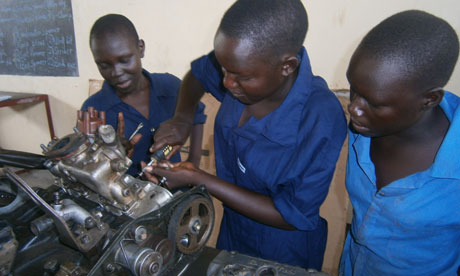
Trainee female mechanics (left to right) Nura, Natalina and Gloria in the workshop. Photograph: Laura Powell for the Guardian

Laura Powell
The Guardian,

Nura Koleji rubs her toe in the ochre dust, hugs her knees to her stomach, and keeps her eyes firmly downcast – until we hit on the one topic she is bubbling to talk about. It is not how she fled her village of Lanya when AK47-wielding soldiers arrived from the north during the Sudanese civil war. Nor how they kidnapped her brother to train him as a child soldier; how she watched as they picked out victims and shot them; or how her two uncles were among those butchered in front of her.
It is not even the topic I am here to speak to her about – why she decided to train as a mechanic. What really riles Nura is men's dominance in the workplace. Last week South Sudan, became an independent country following a 22-year war that ended in 2005. And in this brand new country, women such as Nura are keen to see changes.
"We have a saying that one hand is not enough to clap. It's true," she tells me. "We need both sexes, not just one. There's an hereditary attitude in my village that women are weaker. I ignore those words and despise the people who say them because I have louder words in my heart telling me I am strong."
Nura is not an activist; she has never heard the word "feminist". She is a 20-year-old, softly spoken Sudanese girl, wearing oil-slicked blue mechanic's overalls. When she graduates next year she, along with three other female classmates, will have defied the odds to become the first women mechanics in South Sudan.
By the time we meet at 9am, I've dressed, had breakfast and negotiated the potholed roads of Juba, Southern Sudan's de facto capital, to reach the technical college, a secondary school where the 470 students (85% of whom are boys) train to become electricians, bricklayers, carpenters or mechanics. Nura, meanwhile, has collected water from a borehole, swept her family's compound, poured tea for her six younger siblings, revised, and picked mangoes before her two-hour walk to school. After classes finish at 3pm, she will sell the fruit at Juba market and put the earnings towards her £41-a-year school fees.
As her 16-year-old classmate Pamela Daniel says: "If you live here, everything is a struggle. But if you don't struggle, you may as well spend your life asleep because nothing will come to you."
Nura chose this profession partly because she loves cars, partly because she would love to drive (but has neither the money nor facilities to learn), and partly because she wanted technical skills and a trade, rather than a traditional academic education. One motive, however, supersedes the rest; Nura believes there are no female role models in Southern Sudan and her ambition is to become the first.
This is quite a task for a girl whose mother is absent (she was separated as they fled Lanya during the war), whose father has no job, and whose income from trading mangoes leaves her with just enough money to pay school fees and buy shoes, but not enough for an exercise book. Even so, Nura has already overcome obstacles that halt the education of the majority of her peers.
Though 87% of Southern Sudanese women are illiterate, Nura and her classmates can read. While they live with their parents, the majority of girls in South Sudan girls are married off at 13. "Parents value the dowry more than their girls' education and freedom," says English teacher Emelda Elizulai Melling. And with the average dowry around 200 cows (vast numbers of the population earn less than £97 a year and the cheapest cow costs £280), it is not hard to understand why.
Even menstruation is a challenge. "When a girl has her period, she does not attend classes because she doesn't have the appropriate facilities," says Angelina Alel Habib, spokeswoman for Plan International in Southern Sudan. Luckily for Nura and her classmates, their teacher spends part of her wage on sanitary towels for the girls.
Then there is the fact that as the only four female mechanics students in a class of 60 boys, they faced relentless teasing and family opposition. "My neighbours laughed [at] my overalls. They said girls should not be mechanics," says 17-year-old Natalina Kiden, who would like to be a chauffeur but "doesn't want to rely on men for anything" – not even fixing a car.
Pamela, who hopes to train as an aeroplane mechanic, spent three days persuading her mother to let her go to technical college. "She thought automechanics was a dangerous and dirty job for men," says Pamela.
Nura, meanwhile, likes her overalls, despite the ridicule they provoke. And she doesn't worry that men might find her independence unattractive, or that when she marries, her husband might ban her from working. "I'll talk to my husband in a polite way and make sure he accepts my work," she tells me. "He will not refuse. I am determined. I will keep talking until he lets me."
This, after all, is a society with stringent gender-based traditions. "When women pour water for their husbands, they must kneel as a sign of respect," says Habib. And while sharia law was not imposed in the south of Sudan as it is in the north, its strict code has still restricted women's behaviour; for instance women are not supposed to speak in public. "One of the exciting changes our independence will bring is that women will finally be able to speak freely," says Habib.
Other equalities, such as increasing numbers of women in the workforce from the current 30%, will inevitably take longer. "It is not easy for men to adjust to the new economic status of women," warns mechanics teacher Francis Osumba. Juba college, which was built in the 1950s, only began accepting female students in 2005 to study bricklaying, and automechanics in 2008.
So far the students have mastered welding and engine cleaning, learned the entire anatomy of a car and even been taught how to make tables and chairs using scrap sheets of zinc – despite a poorly equipped workshop.
Nura dismisses these obstacles with touching optimism. Does she worry that male owners of car repair firms will be reluctant to hire a girl? "No," she says, insisting she will instead be a walking role model when women see her on the street in mechanic's overalls.
Osumba agrees: "The girls want to disprove people who say mechanical work is just for boys. It is not easy for them but they've passed their first and second year exams so why shouldn't they be given the same chance as the males?" Why not, indeed.
• To hear more about Juba's students: http://www.guardian.co.uk/global-development/interactive/2011/jan/11/southern-sudan-juba-students-audio-slideshow

Friday, July 8, 2011

Modern Muscle

Muscle Cars, No Midlife Crisis Required

Big Engines, Throwback Looks Lure Baby Boomers and Twentysomethings; But Rising Fuel Prices and Regulations Loom

By JOSEPH B. WHITE at the Wall Street Journal

Detroit muscle-car mania is back.
For the first time since the Carter administration, three big Detroit brands, Ford, Chevrolet and Dodge, all offer rear-wheel-drive coupes that boast a distinctively American blend of in-your-face styling and big horsepower numbers.
How big? Try a 444-horsepower Ford Mustang Boss 302, which can be ordered with a special "Laguna Seca" package that essentially makes it a street-legal race car. Or consider the forthcoming 2012 Chevy Camaro ZL1 that will deliver 550 horsepower from its supercharged V8. Meanwhile, Chrysler LLC offers a Dodge Challenger model with a 470-horsepower Hemi engine that can run from 0 to 60 miles per hour in under five seconds.
These monster engines are shoehorned into back-to-the-future body styles that telegraph the core target market for the cars: baby boomers who lusted for these cars in their teens and 20s, but settled for Japanese compacts, minivans and sport-utility vehicles. Equally important to Detroit marketers, though, is capturing the imagination of car enthusiasts who don't remember the '60s and '70s—they weren't born yet.

"It's the attitude of the customer," less than demographics, says Mustang brand manager Jim Owens, who has a customized Mustang of his own that packs 650 horsepower under the hood. It is an attitude that says, "Hey, look at me!" he adds.
For Detroit car makers that were struggling to survive just two years ago, the buzz generated by muscle cars provides a much-needed shot in the arm for their brands. The official Mustang Facebook page, for instance, has more than 1.5 million followers—about twice as many as the Ford Motor Co. Facebook page.
But similar to the mid-1970s, when fuel prices soared and new regulations forced auto makers to shift strategies, a cloud is gathering over the muscle-car party just as it is revs up. Amid gyrating gas prices, the Obama administration is pushing a proposal that could boost fuel-economy standards to 56 or 60 mpg by 2025, leaving muscle-car makers with some tough choices down the road.
The current revival "can last for a few more years until the fuel-economy standards become ever tougher," says retired GM Vice Chairman Bob Lutz, the patron of the Camaro's rebirth. To raise fuel economy, future muscle cars might feature the superefficient eight- or nine-speed transmissions beginning to appear in luxury cars, or have electric-hybrid systems, though these technologies would add thousands to the cost of the car, Mr. Lutz says.
High mileage standards could make V-8 engines an expensive rarity, says Jeff Schuster of the market research firm J.D. Power and Associates. But Mr. Schuster says muscle-car style could survive in more affordable cars that simply used smaller engines under the hood.

"You'd see V6 or even turbocharged four cylinders," he says. Buyers could get "a muscle shell, but not the muscle car."
For the time being, though, the new approach appears to be working. Sales of the Camaro and Challenger rose 13% and 10%, respectively, in June, outpacing growth in sales of all passenger cars, according to Autodata Corp. Mustang sales slipped 2%, but on average, customers paid more than $36,000 to buy one, up nearly 12% from a year earlier, according to data from AutoTrader.com.
"The performance per dollar was hard to beat," says Juan Barnett a 30-year-old Defense Department employee who drives a 412-horsepower, V8 Mustang GT around Washington, D.C., and maintains a blog for enthusiasts. Nostalgia for the late '60s Mustangs had little to do with his purchase, he says, since the Mustang GT is a fast, sporty car that can still accommodate a child seat for the baby he and his wife are expecting.
Car lovers of a certain age may like to reminisce about the glory days of American muscle, but buyers of today's muscle cars are getting better vehicles by every measure, beyond just room for a baby seat.
The 1967 Camaro Z28, for example, had a V-8 engine rated at 290 horsepower. That's less than the V6 version of the 2011 Camaro, rated at 312 horsepower and 29 mpg on the highway. About half of Mustangs and two-thirds of Camaros are rolling onto the street with efficient, but strikingly powerful V6 engines, as consumers hedge against high gas prices. Today's muscle cars also come with airbags, stability control and robust brakes, which were all lacking in the classics.
Chevrolet marketing executive John Fitzpatrick says Camaro buyers cluster in two age bands—20 to 30 years old, and 45 to 55.
"We definitely see more than a baby boomer audience," he says.
GM's successful tie-in with the popular "Transformer" movie series is one element of the auto maker's strategy for cultivating the next generation of enthusiasts. Chevy is launching a limited run "Bumblebee" Camaro, with a distinctive yellow paint job and bold black stripes, that looks like the Camaro that transforms into a fighting robot in the latest Transformers film.
Angela Naff of Henry, Va., says she bought her first Camaro in 1995. Now she's a collector and owns six of the new models, which she drives to gatherings at the Charlotte Motor Speedway in North Carolina and other places where enthusiasts show off their cars and swap stories.
"It's just a passion," says Ms. Naff, a personal-fitness trainer who runs a website for Camaro fans. She keeps an eye out for Camaros with unusual colors or option packages to add to her collection. "They had an orange with white stripes," she says. "We jumped on that."
As for Dodge, the Challenger ran behind the Mustang and Camaro in sales years ago, and it does again today, selling about 3,300 a month, or less than half the Camaro's and Mustang's sales in June. Those sales figures have prompted speculation in the auto-industry press that the car and its strongly retro styling statement won't last.
Chrysler says it has worked to upgrade the car's performance, adding a new 305 horsepower V-6 engine that gets 27 mpg on the highway, up from 25 mpg for the previous V6. The Challenger SRT8's Hemi engine has a feature that shuts off four cylinders to save fuel on the highway, and the interior of the car has been reworked. Sales are up 14% so far this year.
And last year, Chrysler offered a "Furious Fuchsia" Challenger in a limited run of just 400 cars.
These low-volume variations of modern muscle cars have a shot at becoming collectors' items in 30 years, just as their 1960s and 1970s originals are today.
Write to Joseph B. White at joseph.white@wsj.com

Friday, June 24, 2011

Safety First

Here is some sad news. Please if you're working on a car remember the following.
Always use jack stands, not just jacks.
When using jack stands use on a level, solid surface (no hills, no gravel/sand).
Certain dangerous jobs should not be tried by the amateur such as work on changing glass panes and removing the gas tank.
Read the safety section of your vehicle repair manual before undertaking a job for the first time or if it is the first time in a while.


SUV slips off jacks, kills man

By ANTHONY SIINO-Staff Intern Posted: 06/23/2011 01:10:59 AM PDT
The Chico Enterprise-Record

MINERAL — A Tehama County man died under the weight of his SUV while camping at Battle Creek Campground Friday.

Casey Ellsworth, Sr., 36, of Los Molinos, suffocated after his Mercury Mountaineer fell off its jacks while he was under it, said Sgt. Rod Daugherty of Tehama County Sheriff's Office. He was repairing the bearings and the inner seals of the rear wheels on a level shoulder of Highway 36 about a tenth of a mile from camp. He was a father to five children.

The vehicle's front wheels were chocked and it was raised on two jacks, one on the rear axle and the other near the rear bumper, Daugherty said. Somehow the 4,500-pound vehicle slipped off the supports.

"That's not something you come across too much," Daugherty said.

A passing motorist spotted his body and called the Sheriff's Office. No foul play is suspected.

Ellsworth was with his fiancé and her father before the accident, who helped him set up and secure the raised SUV, said Aaron Ellsworth of Paradise, his brother. Casey Ellsworth sent them into town to get parts and there was no reason for him to go back under the SUV without the parts.

"This whole past week has been a whole, total roller coaster for all of us," Aaron Ellsworth said.

His family is now struggling to find a way to handle the remains, as any Tehama County programs that could cover the costs only applied for Casey, not his family members footing the bill from Paradise.

"Even before this, we were all scraping bybarely," Aaron Ellsworth said.

A memorial fund to help pay for cremation has been set up at Sierra Central Credit Union by Leslee Libby, Casey Ellsworth's mother. The memorial service will be held at 2 p.m. Saturday at the Magalia Pines Baptist Church. The fact Casey Ellsworth had no life insurance isn't helping the family, who didn't expect to cope with his loss any time soon.

"Most people prepare," Libby said. "I couldn't even prepare."


Fiery explosion during car repair burns three in Folsom

blindelof@sacbee.com (Bill Lindelof and Matt Kawahara)
The Sacramento Bee

Three people, including a 6-year-old child, were burned in Folsom Monday night when a fire exploded during the removal of an SUV's gas tank.

Firefighters were called to the 100 block of Briarcliff Drive shortly after 9 a.m. When they arrived, firefighters found a Dodge Ram sport utility vehicle was ablaze, a fence was burning and a tree was engulfed in flames.

One man had suffered moderate to severe burns to his arms and chest, a second man had minor burns to his face and hands and the little boy had moderate to severe burns. All the victims were transported to the hospital.

Folsom police determined that the two men had been removing a gas take from the SUV when the fire ignited. The exact cause of the fire and resulting explosion has not been determined.

Thursday, June 2, 2011

VW opens Tennessee plant with new focus on quality

From the LA Times
May 28, 2011

Reporting from Chattanooga, Tenn.-- Volkswagen, whose cars have been known to have nagging reliability problems, is hoping Passat sedans rolling out of its new $$1-billion factory here won't need a lift from the city's historical hallmark — tow trucks.
Nearly a century after claiming its fame as the birthplace of the wrecker, Chattanooga is again in the automotive spotlight as VW looks to regain traction in the U.S.
"We know what we have to do here, " said Hans-Herbert Jagla, who heads human resources at the factory. "Everyone should know that the customer is expecting a perfect car."
VW, the world's third-largest automaker, is looking to triple U.S. sales over the next seven years. But to reach that goal, it needs to overcome a troubled history.
Its previous effort to manufacture cars in the U.S. was an admitted debacle. Quality problems and slumping sales prompted VW to close its first U.S. factory in Westmoreland County, Pa., more than two decades ago.
It was a huge setback for the company that brought the iconic Beetle across the Atlantic, making VW America's first import darling.
VW has recovered some ground in recent years. The brand sold 256,830 vehicles last year, a 20% gain from 2009, according to Autodata Corp., but that was about half of what it sold during the boom years of the 1970s. Sales are up 17% through the first four months of this year.
VW continues to be plagued by quality problems, which is why Jagla said the automaker has been stressing high production standards to the 1,700 workers at the new factory. They are critical to the automaker's growth plan, he said.
The VW nameplate ranked 29th out of 34 brands in the J.D. Power and Associates 2011 reliability rankings of cars after three years of ownership. It ranked 31st out of 33 brands on the Power's 2010 initial quality survey of vehicles 3 months old.
"We have really tried to draw our lessons from the Westmoreland experience," said Frank Fischer, chief executive ofVolkswagen Group of America, Chattanooga Operations.
Built on 1,400-acre complex east of town at the site of a former explosives factory, the plant opened this week with a different management structure than VW's previous factory.
Managers of the failed Pennsylvania factory closeted themselves in Detroit and were rarely present at the plant. This time, VW pulled in more than 200 company experts from operations around the world, including its high-end Audi and Bentley divisions, to work at the factory.
The Passat built in Chattanooga was designed specifically for the U.S. market and won't be sold in Europe. It has an additional 3 inches of rear seat room. It also comes standard with options Americans expect such Bluetooth and dual-zone climate control. The base European engine produces 122 horsepower, contrasted with the U.S. model, which starts at 170 horsepower, providing the type of merging and freeway acceleration American drivers often equate with a sense of safety and security.
The car, equipped with a manual transmission, will start at about $$20,000. Automatic transmission models and versions with larger engines, including a turbocharged diesel with expected highway fuel economy of 43 mpg and a driving range of 800 miles, will start at about $$26,000.
VW needs the vehicle to be a success. An earlier Passat was once the automaker's star performer, selling more than 96,000 vehicles in 2002 and accounting for more than 28% of the company's sales volume, according to Edmunds.com. Sales dwindled to less than 12,500 last year.
Initial plans call for the factory to produce about 56,000 vehicles during its first year of operation, although VW officials say the number could change.
Growing volume will be key for Volkswagen to meet its target of U.S. sales — including its Audi division — of more than 1 million vehicles per year by 2018. It wants to reach a U.S. market share of 6% in that time frame. Currently, the company, including Audi, has annual sales of 360,179, accounting for 3% of U.S. auto sales.
"This is VW's first run at making cars tailored to the American tastes and at parity in price and size with the Toyota Camry andHonda Accord, the cars that dominate that segment." said Bill Visnic, an analyst with auto information company Edmunds.com.
Early reviews of the Passat credit VW for increasing the size and reducing the price from previous versions. Visnic, however, said its conservative styling won't draw much attention.
"The Passat is not a breakout car for VW and somewhere along the line they are going to need some breakout products if they are going to reach those sales goals," he said.
VW sees building cars in the U.S. as an important strategy. The new factory has the capacity to produce 150,000 vehicles a year and there's plenty of room to expand at the sprawling site.
"Localization reduces vulnerability of extended supply chains, and being closer to the consumer allows for a faster response to trends and demands," said Efraim Levy, a Standard & Poor's equity analyst.
It also limits exposure to currency exchange rate swings.
The heavy reliance on parts imported from Europe and unfavorable exchange rates contributed to the previous factory's demise, Fischer said. Now, about 85% of the content of the American Passat will come from NAFTA countries, which eliminates much of he currency risk, he said.
The plant may also benefit from its location along the southern tier of a corridor known as auto alley for its concentration of car factories. It has good highway connections to a Mercedes-Benz plant in Alabama and a BMW factory in South Carolina. Fischer said the German automakers tend to share suppliers, including a company that stamps sheet steel into car body panels.
VW officials also won't have to go far to be reminded about improving the quality its cars. A few miles from the factory is the International Towing & Recovery Hall of Fame, where a display pays homage to Ernest Holmes Sr., the inventor of the tow truck.
"An auto plant is the holy grail of economic development," said Chattanooga Mayor Ron Littlefield. "This is a wave that will carry us forward for a decade."
Copyright Los Angeles Times 2011
Powered by LSN, Inc.

Story posted 2011.05.27 at 04:03 PM PDT

Monday, May 2, 2011

Paul Newman's Volkswagen Beetle

Paul Newman's Volkswagen Beetle once rocked the motor racing world

Beneath the modest exterior of the 'Newman Bug' beat a 351-cubic-inch heart — the late actor, a racing buff, had the 1963 VW customized as a 'sleeper' racecar. Now it can be yours … for $250,000.


By John Scheibe at the Los Angeles Times
5:30 PM PDT, May 1, 2011


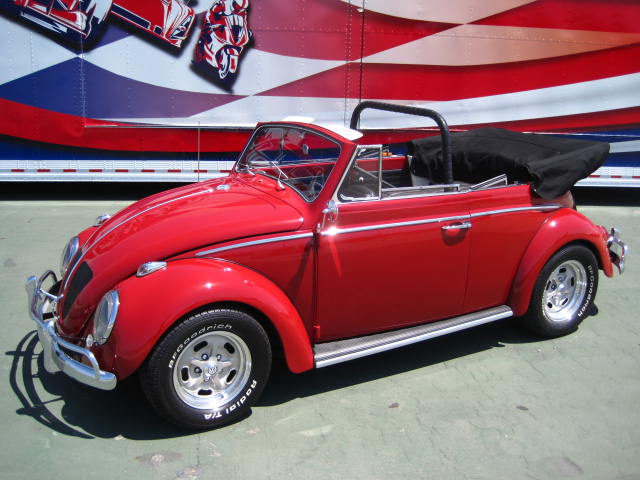
The red 1963 Volkswagen convertible in the "For Sale" ad appears to be a cherry version of the automaker's popular Beetle. It has chrome bumpers, a black cloth top and a bright finish to its paint. The rims are shiny and the tires barely worn.

The trim little California car looks ready to drive to the beach or cruise down the Sunset Strip on a Saturday night. But buckle your seatbelt before you get to the asking price — $250,000.

Obviously, this is no ordinary Volkswagen. Indeed, it has an extraordinary history. In car talk circles, it's known as the Newman Bug, the VW that the late Paul Newman had customized into a "sleeper" racecar in the late 1960s.

It's an Indy Bug with a 300-horsepower engine, racing suspension and five-speed gearbox. On the outside, it looks like Herbie the "Love Bug." But try to beat it off the line and it will blow off your door handles.

Newman bought the car in 1963, and later he and the convertible appeared in some magazine advertisements for Volkswagen. In 1969, he asked Jerry Eisert, a renowned Indy Car builder in Costa Mesa, to make some modifications on the car, which included installing a bigger motor.

Eisert took out the backseat and replaced the stock VW motor with a Ford 351-cubic-inch engine — the equivalent of putting a rocket on a kid's red wagon. After Eisert's work was complete, Hollywood gossip had Newman racing the car on Mulholland Drive with some of his industry pals and also competing against all comers at local racetracks. Cool Hand Bug.

Newman's passion for racing blossomed after he made the 1969 film "Winning," and the experience of learning how to drive for that movie turned into a second career. For the next 15 years, he was a successful driver on the Sports Car Club of America circuit and, driving a Porsche, finished second at the 24 Hours of Le Mans in 1979.

Newman once told ESPN, "It actually took me three years of rearranging my schedule before I could find time to get my license and everything. After that, I never did a film between April and September or October. [Racing] was all I did."

In preparation for "Winning," Newman and the film's co-star, Robert Wagner, took lessons at Bob Bondurant's driving school at Riverside Raceway. Soon after, Bondurant moved the school to Ontario Motor Speedway, and it was there one night in 1969 that Newman met Sam Contino, head of the automotive technology department at Chaffey College in Alta Loma.

Contino and his students were testing a car they had built — a Trans-American Sedan Series Camaro — as part of their "race car preparation technology" class, a three-unit course.

According to Contino, that night John DeLorean brought a new 1969 Camaro to the track for Bondurant, and Newman, who was on the speedway's board of directors, was putting a Formula Four open-wheel racer through its paces.

When Newman saw Contino and the students, he introduced himself.

"He looked at our Trans-Am Camaro and asked if he could drive it," Contino, 82, recently recalled. "After he drove it, he said, 'I'd like to show you one of my toys.'"

That's when the Chaffey class first saw the Newman Bug.

Newman told Bondurant that he was thinking of giving up the Volkswagen, but didn't know what to do with it. Bondurant suggested that he donate it to Chaffey's auto tech department.

"He said, 'It's yours if you want it,'" Contino said. "I had gotten some Chaffey jackets from the football team for our students to wear and we gave him a jacket." From then on, Newman was a sponsor of the Chaffey program.

The class added the Newman Bug to its collection of cars, which included a Trans-Am Boss 302 Mustang and two Ramblers that had been part of the James Garner Racing Team. The class turned one of the Ramblers into a Baja car for competition in Mexico road races and the other into a dragster.

They painted the VW the Chaffey school colors, white with red trim, and put on four Keystone chrome rims. Although they prepared the car for racing, it was used mostly as a training aid to show workmanship and construction.

In 1986, Contino retired from teaching at Chaffey and the school presented him the Newman Bug as a retirement gift. Contino and his son, Tom, did a complete restoration of the car in April 2009 and had plans to show it to Newman. But the actor died before the car was finished.

"The car is a tribute to Paul Newman for all that he did for us," Sam Contino said.

The Newman Bug was recently shown at the Long Beach Grand Prix, where it drew sizable crowds. "People look at it from a distance and think it's just a Volkswagen," Contino said, "but then they get closer and see the big Ford motor where the back seat should be, and it blows their minds."

Mostly, though, the car sits in Tom Contino's garage in Hesperia, awaiting a new owner.

"Sometimes I drive it around the block," Tom Contino said, "and my wife will take it out for ice cream."

Sam Contino said he hopes a car collector will buy it. Or, if a museum was interested, "I would be willing to give it up."

Additional photos and information about the car are available on the websites oldbug.com and californiacar.com

john.scheibe@latimes.com

Tuesday, April 19, 2011

VW Bulli Bus Concept

This little number is a concept car with microbus genealogy. Would you drive it?

Volkswagen Reveals Redesigned Beetle


By Jonathan Welsh

Volkswagen AG unveiled its redesigned Beetle (call it the new New Beetle) today, and as expected it looks a bit sportier and more aggressive than the previous model, which has been around since the 1998 model year.
But really, it isn’t much of a departure from its predecessor, and after the hype-heavy buildup that started last year, the new car is a letdown. Why not just say you’re going to make minor tweaks to the car’s appearance, revamp the suspension and just roll with it. I was halfway expecting the return of, well, maybe the Karmann Ghia.  
But a car with the Beetle’s signature shape is limited in how sporty and aggressive an image it can project. Even the original Beetle, the people’s car, was largely regarded as an automotive parody in the U.S. And for the last 13 years the New Beetle has been a caricature of that parody. It looks like the original but has none of the mechanical features that largely necessitated the old Beetle’s shape like a rear-mounted engine and cargo trunk up front.
The 2012 Beetle come with a 2.5-liter five cylinder gasoline engine, a 2-liter diesel or a 2-liter turbocharged gas engine. Transmission choices include a 5-speed manual, 6-speed automatic or 6-speed dual-clutch version, depending on the model.
The long-running New Beetle was more of a Rabbit or Jetta in disguise — a retro gimmick that sacrificed function in the name of form. A lack of useable interior space was a longtime problem with the Beetle, especially for anyone who had to ride in the cramped back seat. While never a huge seller, the Beetle has put up fairly reliable numbers for VW. The company sold 55,842 Beetles in 1998, its first year on the market. Last year it sold 16,537.  
In November Volkswagen used “The Oprah Winfrey Show” as a platform for launching the redesigned Beetle roughly a year before it was to go on sale. Winfrey showed a silhouette of the 2012 Beetle, and then said she’d give one to each member of the studio audience — 275 cars in all.

Wednesday, April 6, 2011

Workshop makes industrial tools available to anyone

Workshop makes industrial tools available to anyone


By Marcus Wohlsen, Associated Press


SAN FRANCISCO — In the tech-obsessed South of Market neighborhood that digital sensations like Twitter and Zynga call home, a newfangled workshop for would-be inventors blends a startup sensibility with the area’s historic manufacturing roots to give geeks a chance to get out from behind the keyboard.
Modeled after gyms, TechShop is attracting members who pay as little as $100 a month to use industrial strength equipment to invent whatever they can imagine.
“Everybody on the planet has ideas for things they want to make,” says TechShop founder Jim Newton, who wants to bring TechShops to cities across the country.
The 17,000-square-foot workshop is nestled in the middle of what was once an industrial hub where ironworks forged equipment for the Gold Rush and later ships during war time.
Housed on two floors of a building that might otherwise have become loft condos, there are workshops for working with wood, metal, plastics and textiles, plus an electronics lab and computer design stations. Startups can even rent offices there by the month.
The biggest machine of all may be a huge contraption that shoots a thin slurry of water mixed with industrial gemstones at 1,800 mph to cut through thick slabs of stainless steel. Upstairs, a 3-D printer molds objects out of plastic straight from a digital file.
Perhaps the most popular tool at TechShop is the laser cutter, a $30,000 metal box delicate enough to engrave paper but powerful enough to cut thick leather. Chief Executive Mark Hatch says one of TechShop’s most popular events is an evening called “Lasers and Beer.” ”The sequence is very important,“ Hatch jokes. (First the lasers, which they use to etch designs into glass mugs, then beer.)
One laser cutter fan is Marie LaCour, who started her kids’ party invitation business, Goobitty Goo, after getting laid off from her graphic design job of 14 years.
”After losing my job, I thought I’d try to go ahead and do this full time,“ LaCour said. Trying to figure out how to get started without buying the expensive tools herself, she came across TechShop in a Google search, she said while running off a batch of invitations on the laser cutter one recent afternoon. A year later, she says, ”this has become my office.“While the staff works to maintain a playful vibe, Hatch is deeply serious in his belief that giving more people access to more tools can transform societies and economies. And he says that the tools available today make that possibility more realistic than ever.
Members must take classes that include extensive safety briefings before they can use specific equipment. Yet the less mechanically inclined don’t really need to get their hands dirty: software has near complete control over some of the most complex machines. Hatch claims this makes the path from idea to object a simple straight line.
“We can turn you into what would have historically been a master craftsman in about two class sessions,“ Hatch boasts.
The ex-Green Beret cites Karl Marx’s observation that the Industrial Revolution took manufacturing tools out of the hands of artisans and gave them to industrialists. For Hatch, TechShop is a way to give those tools back to stir what he hopes is an entrepreneurial uprising.And he says TechShop members already have the inventions to prove it.
After Jack Dorsey co-founded Twitter, his next idea was to offer a device that lets anyone with a bank account and a smartphone accept credit cards. Dorsey’s business partner, Jim McKelvey, designed and built a prototype at TechShop in Menlo Park.
Dorsey says his company Square currently processes more than $1 million in transactions per day.
Despite his current aspirations, founder Newton says that his original motive for starting TechShop was purely selfish. He wanted his own shop, but he didn’t want to have to make stuff for clients in order to fund it. He just wanted a place to play, and he wondered if the gym membership model might be a way to make that possible.
Newton dropped out of college in the 1980s to get into the emerging computer graphics industry. He worked in software until the first Internet bubble burst at the turn of the century, and he knew he wanted to get back to doing something with his hands.That passion led him into the world of BattleBots, where contestants build homemade robots with the intention of destroying one another.
From there, he became a science adviser on the popular Discovery Channel show Mythbusters, where ex-special effects wizards perform gonzo science experiments. Newton’s tasks included building a ”death ray“ out of mirrors they hoped would focus enough sunlight on a boat to set the vessel on fire.Newton opened the first TechShop on a shoestring in Silicon Valley’s Menlo Park in 2006. Since then, the shop has grown to nearly 900 members. The San Francisco location opened in December and has nearly 500 members.
Another location has also opened in Raleigh, N.C. In the next year, the goal is to franchise the TechShop model across the country, including a special joint project with Ford Motor in Detroit. The hope is that democratizing the tools of innovation can lead to economic revitalization. Toward that end, the San Francisco location houses the permanent office of a city-backed San Francisco non-profit, SFMade, that helps inventors turn their ideas into businesses in hopes of creating more manufacturing jobs.
For Newton, the idea of TechShop seems so simple and straightforward he still can’t believe someone didn’t come up with it before he did.
”It amazes me that nobody’s done this yet,“ he says. ”It seems like a dumb, obvious idea that there should be these things all over the place.“
Copyright 2011 The Associated Press. All rights reserved. This material may not be published, broadcast, rewritten or redistributed.

The Best Cars for Teen Drivers

This article talks about the best cars for teen drivers but I'd like to add these might also be good cars for elderly drivers who have less limb strength, slower reaction times, and are more frail in the event of a crash. Make sure your elderly relatives have cars with power steering and power brakes, preferably with an automatic transmission. Check to see they can step in and out of the seats without difficulty. Also check that the blind spots are not too large. Car dealers can turn of air bags if a driver (or regular passenger) is too lightweight to take the hit.


The Top Cars for Teens: Better Safe Than Sporty


From the Wall Street Journal. There's lots of multimedia content so go to the link to see it all!

Mercury Montenegro 2005-2007
Mercury Sable 2008-2009
Lexus ES 330, 2004-2006
Honda Accord 2003-2007
Toyota Prius 2004-2009
Subaru Legacy 2005-2009
Acura TL 2004-2008
Ford Five Hundred 2005-2007
Chevrolet Malibu 2004-2007
Honda Pilot 2006-2008
Toyota Rav-4 2004-2005

Honk if you want to stop your 2011 Jetta

Honk if you want to stop your 2011 Jetta
By CNN
Posted March 28 at 5:26 p.m.


Volkswagen of America is recalling about 71,000 2011 Jetta sedans for a wiring problem that could cause the car to turn off when the horn is used.
Under certain rare circumstances using the horn could cause a short circuit that would, in turn, cause an electronic part called a converter box to disconnect from the car’s power supply, a VW spokeswoman said.
The converter box supplies power to various components, including the headlights, wipers and engine controller. Cutting off power to the engine controller shuts off the car’s engine.
VW is not aware of any accidents or injuries resulting from this problem, Volkswagen of America said in an announcement. The recall affects Jettas built between March 2010 and March 2011.
Customers with questions or concerns should contact Volkswagen Customer Care at 800-822-8987, the automaker said.

Tuesday, March 8, 2011

Spiders in Mazda Fuel Lines

Spider webs prompt Mazda recall of 50,000 cars


By Peter Valdes-Dapena, senior writer CNN Money

Mazda is recalling about 52,000 Mazda6 sedans, because yellow sac spiders like to build their nests in part of the fuel system.


"A certain type of spider may weave a web in the evaporative canister vent line and this may cause a restriction of the line," Mazda said in a letter to the National Highway Traffic Safety Administration.


The evaporative canister vent line runs from a charcoal-filled canister that cleans air coming out of the gas tank. Blockage of the line can prevent air from getting into the gas tank as the gasoline is used, resulting in negative air pressure inside the tank. That can lead to a crack in the gas tank and the possibility of a fire.


There have been 20 reported cases of spider infestation in the Mazda6 -- all have been in cars with 4-cylinder engines, none with V6's. No actual fires are known to have been caused by the spiders, according to Mazda's letter.

Dealers will inspect and, if necessary, repair the fuel system in the cars. A spring will also be installed to prevent spider intrusion, according to the letter.

Letters will be mailed to owners of affected vehicles beginning at the end of this month.

It's unclear why this particular spider -- the yellow sac spider -- seems to prefer the Mazda6, company spokesman Jeremy Barnes said. All modern cars have the same type of equipment.

"Maybe they just like cars that go 'Zoom-Zoom," he said. "We honestly don't know."

Yellow Sac Spider (c) Richard Bartz


Spiders may have entered Mazda cars before assembly, expert says


The infestation, in which yellow sac spiders nest in hoses, 'is probably going on at some warehouse,' an entomologist says. Mazda disagrees. It has recalled 65,000 cars.

Could new cars have come with spiders?

Mazda's spider problem could be the result of an infestation by the venomous arachnid at an auto parts supplier or the Flat Rock, Mich., plant where the automaker assembles its Mazda6 cars, rather than at the garages of owners, an entomologist said.

This week, 
Mazda Motor Corp. said it would recall 65,000 cars to fix a problem with spiders nesting in tiny rubber hoses linked to fuel tank systems that could cause pressurization and ventilation problems in certain cars.

The Japanese automaker said the infestation by the yellow sac spider, or 
Cheiracanthium inclusum, could cause fuel leaks and even fires.

"It is a serious problem.... The gas tank could crack, and we want to make sure that every owner of a Mazda6 brings their car to a dealer and have it checked," said Jeremy Barnes, a spokesman for Mazda North American Operations.

John Trumble, a 
UC Riverside entomologist, has an idea about when the spiders entered the fuel systems.

"These spiders are not getting into the cars while they are parked at homes," he said.

Trumble said the spider is a "nocturnal hunter" that hides during the day and goes in search of prey at night.

"This is probably going on at some warehouse. The inside of a tube is the perfect place to spend the day waiting for night to go hunting," Trumble said.

The spiders probably crawled into the tubes before some worker shipped the tubes to the assembly plant or placed them in cars, he said.

Barnes said Mazda believes the spiders are entering the vehicles after they leave the factory. He noted that one vehicle was at least two years old when the problem was discovered, and Barnes doubted that either the spider or the gas tank could have survived that long if the problem began before assembly.

"The tank is just not engineered for that type of blockage," he said.

How the spiders got into the fuel systems remains a mystery, Barnes said.

Trumble said Mazda should check the tubes in storage at the factory and at any suppliers.

There are no reports of auto workers, mechanics or drivers being bitten by the spiders in the cars. And there are no reports of gas tanks cracking or of any accidents or injuries related to the problem.

The yellow sac spider is indigenous to all but the most northern states in the U.S. and accounts for a large percentage of spider bites in America.

According to an Ohio State University report, the spider is mildly venomous, causing a reaction similar to a mosquito bite, but can be more dangerous to some individuals. As with bee venom, some might experience "general systemic reactions that include fever, malaise, stomach cramps and nausea" and, in extreme cases, an ulcerated lesion that takes weeks to heal, the university said.

Mazda announced the recall after dealers around the country found 20 cases of the arachnid infestation. It includes 65,000 Mazda6 cars from the 2009 and 2010 model years in the U.S., Canada and Mexico. It seems to occur only in the four-cylinder version of Mazda6.

Dealers who find evidence of the spiders will clean out or replace the hoses and, if necessary, swap out the gas tank.

Pest infestations of vehicles are not all that uncommon. Messy, food-strewn vehicles are known to attract cockroaches, and there are reports of bees and wasps making nests in autos. Rats sometimes nest in the engine compartments of parked cars and chew away at the wiring.

A spokesman at the 
National Highway Traffic Safety Administration said the agency was not aware of any previous recalls caused by pest infestations.
jerry.hirsch@latimes.com
tiffany.hsu@latimes.com